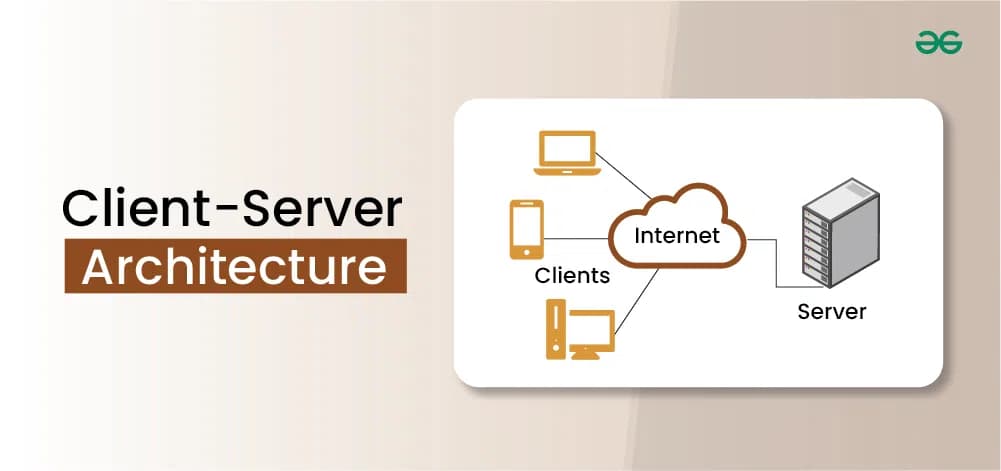
Picture a restaurant, not a router
Every time you open a website, something very restaurant-shaped happens behind the scenes. You, the customer, sit down, a waiter carries your order to the kitchen, the kitchen cooks it, and the waiter brings your food back. Swap "customer" for client, "waiter" for network, and "kitchen" for server, and you've basically just learned client-server architecture.
Who's who at the table
The client: the hungry customer
Your browser, phone app, or a simple command-line tool is the client. Its job is simple: figure out what it wants, ask for it clearly, and know what to do with whatever comes back. A client never cooks its own food, it just orders and waits.
The server: the kitchen that never sleeps
The server is the kitchen. It holds the recipes (your data and business logic), owns the equipment (databases, file storage, compute), and exists purely to turn orders into meals. Unlike a real kitchen, it often serves thousands of tables at the exact same moment without breaking a sweat.
The network: the waiter running back and forth
Between the client and the server sits the network, the waiter sprinting between your table and the kitchen. This trip isn't instant, it takes time, it can get delayed, and every so often the waiter trips and a plate gets dropped. That travel time is exactly what people mean when they talk about latency.
The request/response lifecycle, step by step
Here's what actually happens between the moment you type a URL and the moment a page appears, mapped straight onto the restaurant:
Finding the restaurant, also known as a DNS lookup. Your browser doesn't know where the kitchen physically lives, so it asks a directory service to translate a friendly name like a website address into an actual location, the way you'd look up a restaurant's address from its name.
Getting seated, also known as connection setup. The client and server shake hands, often wrapped in an extra layer of security, before any food talk begins, like a host confirming your reservation and walking you to a table.
Placing the order, also known as the request. Your browser sends a method such as GET or POST, a path describing which dish you want, and sometimes extra details like headers or a request body, similar to special instructions such as no onions.
The kitchen cooks, also known as server processing. The server reads your order, maybe checks a database, runs some logic, and prepares a response. This is the only part of the whole journey where real cooking happens.
The plate comes back, also known as the response. The server sends back a status code describing how the order went, headers with metadata about the plate, and a body containing the actual content you asked for.
Enjoying the meal, also known as rendering. Your browser takes that response and turns it into the page you actually see, images and all.
Status codes are just the waiter's tone of voice
200 OK: here's your food, exactly as ordered
201 Created: your order has just been added to the kitchen's list
301 or 302 Redirect: this dish moved to another table, follow me
400 Bad Request: I couldn't read your handwriting on this order
401 or 403: you need a reservation for that, or this table isn't for you
404 Not Found: we don't have that dish, and never did
500 Internal Server Error: something caught fire in the kitchen, and it's not your fault
Why "stateless" matters
Here's the part that trips people up: by default, the waiter forgets you the second the plate is delivered. Every new request gets treated like a stranger just walked in for the first time, and that's what "stateless" means in this context. If the server needs to remember you, like keeping you logged in, it needs an extra trick, such as a cookie tucked into your receipt, so the next time you order, you hand that receipt back and the waiter goes: oh, it's you again.
Why this mental model actually helps
Once client-server clicks as customer, waiter, kitchen, a bunch of real engineering ideas stop feeling abstract. A slow website might mean the kitchen is overwhelmed, which is server load, or the waiter is stuck in traffic, which is network latency, or you're waiting on a very complicated dish, which is a slow database query. Scaling a backend often just means hiring more kitchen staff, or splitting one kitchen into several so no single one gets crushed during the dinner rush.
The takeaway
Client-server architecture isn't some mysterious diagram full of arrows, it's a very ordinary interaction you've lived through a hundred times at a restaurant. The client asks, the network carries the message, the server prepares the answer, and the response makes its way back. Once that clicks, most of the web starts to feel a lot less like magic and a lot more like a very fast, very literal restaurant.